
HP Latex 830W Printer
The HP Latex 830 is a 64-inch (1,625 mm) roll-to-roll large format printer built for high-volume production signage, retail display rollouts, vehicle graphics, and soft-signage. It produces up to 36 m²/hr (388 ft²/hr) in 4-pass draft mode and 20 m²/hr (215 ft²/hr) in standard 8-pass mode using water-based HP 873 Latex inks in 3-litre cartridges — three times the ink volume of the 730, dramatically reducing mid-run changeovers. The 830 includes an HP Embedded Spectrophotometer, OMAS Plus panel feed accuracy, and HP Pixel Control for uniform colour distribution. Prints exit dry and ready for immediate lamination. Sold and serviced in South Africa by Graficomp, an HP Amplify Commercial Specialist and certified HP ASDP service partner.
The HP Latex 830W is the white ink configuration of the HP Latex 830 — same 64-inch chassis, same 36 m²/hr draft speed, same HP 873 Latex inks (3L), same spectrophotometer and OMAS Plus capability — with the addition of a dedicated white ink channel. The 830W enables printing on clear, metallic, dark, and backlit substrates using five white print modes (Spot, Underflood, Overflood, 3-Layer, 5-Layer). An Automatic Recirculation System (ARS) keeps white ink in constant motion to prevent settling. A printhead rotation chamber allows white printheads to be stored offline when not in use, eliminating waste on colour-only production days. 9 ink cartridges (8 colour + 1 white, all 3L). 10 printheads total. Sold and serviced in South Africa by Graficomp, an HP Amplify Commercial Specialist.
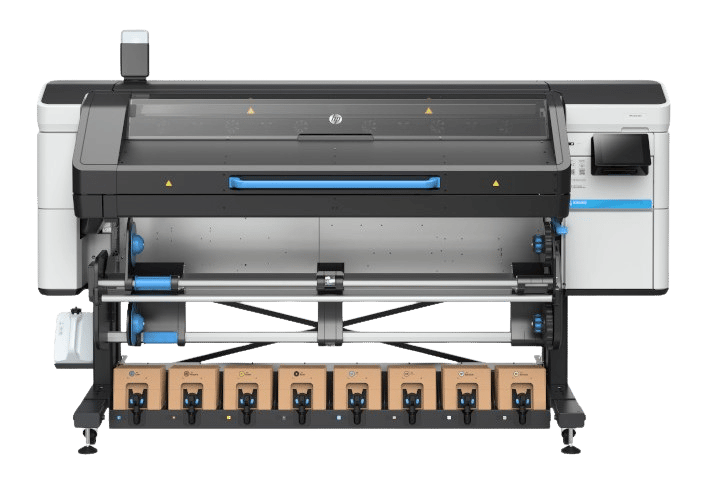

HP Latex 830 Printer — Gen 4 ink chemistry with 3-litre cartridges for sustained high-volume production
HP Latex 830W Printer — white ink configuration with rotation chamber for mixed colour and white ink production
Why the HP Latex 830 Outperforms on Total Operating Cost
The 830 is Graficomp's recommendation for operations printing above 25 m² per day on a consistent basis. These are the operational advantages that determine actual cost per square metre over three years of production — not headline speeds alone.
3-Litre HP 873 Cartridges
The 830 uses HP 873 Latex inks in 3-litre cartridges — three times the volume of the 1-litre cartridges on the 630 and 730. Fewer cartridge changes per production day, less operator time, lower per-ml cost at volume. The Gen 4 ink formulation also delivers 10–15% greater colour gamut volume and richer pigment load than previous generation inks.
Higher Throughput Across All Modes
Draft at 388 ft²/hr (36 m²/hr). Standard 8-pass at 215 ft²/hr (20 m²/hr). Quality 12-pass at 183 ft²/hr (17 m²/hr) — that's the 730's standard mode speed delivered at quality-pass on the 830. For operations where throughput drives capacity decisions, the 830 is the clear step-up from the 730.
OMAS Plus Panel Feed Accuracy
OMAS Plus uses an embedded camera and temperature sensor to monitor media advance over and under-feed in real time, correcting banding before it appears. The system also provides accurate panel length measurement — critical for tiled installations and multi-panel brand rollouts where seam alignment cannot be reworked on site.
Gen 4 Ink Chemistry
HP 873 Latex inks separate the overcoat from the main ink system. Lower curing temperatures (down 30–40°C from Gen 3) reduce thermal stress on heat-sensitive media and extend curing unit service life. Higher pigment load produces richer reds, yellows, and royal blues. Beta testing showed ~85% of production running at 8 or 12-pass with Gen 4 — fewer passes at equivalent or better quality.


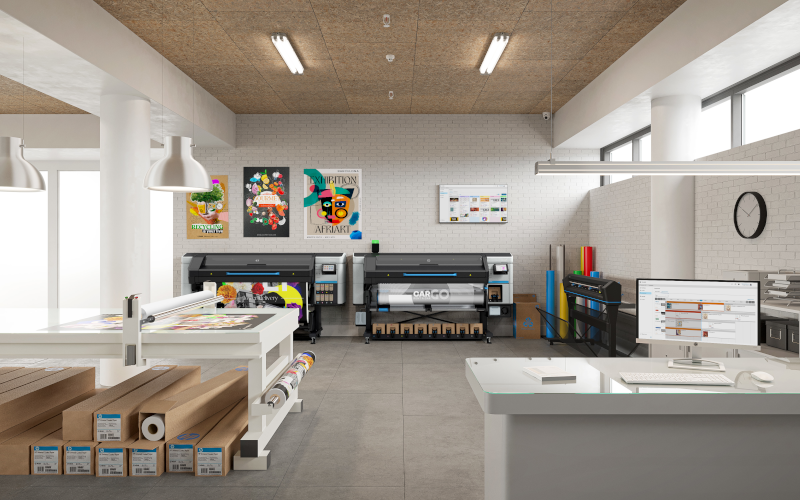
What Our Clients Say
South African print businesses on working with Graficomp.
We run three shifts. The 3-litre cartridges on the 830 changed everything — operators used to interrupt jobs to swap ink. Now that's gone. The machine just runs.
The OMAS Plus system solved our tiled panel alignment problem. We do a lot of multi-panel wall installations. Previously we'd get creep across 20 panels. Now seam alignment is consistent end-to-end.
We moved from eco-solvent specifically for the outgassing wait. Same-day lamination was always possible in theory but never in practice. With the 830, the print comes off the machine ready. Our turnaround on retail jobs is a fraction of what it was.
Graficomp's engineer stayed on-site for two days during installation. We weren't just handed a machine — we were handed a production workflow. That handover is why we came to Graficomp instead of a box-mover.
The 830W opened window graphics and backlit work for us. Jobs we used to subcontract because we had no white ink capability are now done in-house. The rotation chamber means we don't waste white ink on colour-only days.
Output, Speed, and Daily Capacity
The 830 is the production choice for shops running above 25 m² per day consistently. Heavier ink volume per cartridge, higher speeds across all modes, and OMAS Plus accuracy make the 830 the sustainable high-volume choice in the HP Latex roll-to-roll range. For comparison: the 830's quality-mode speed (183 ft²/hr) matches the HP Latex 730's standard mode.
| Print Mode | Speed (m²/hr) | Speed (ft²/hr) | Pass Count | Typical Use |
|---|---|---|---|---|
| Draft (Banner) | ~36 | 388 | 4-pass | Event banners, economy PVC, short-run proofing |
| Speed | ~25 | 269 | 6-pass | General outdoor banners, self-adhesive vinyl, POS |
| Standard everyday | ~20 | 215 | 8-pass | Everyday production: signage, retail graphics, vinyl |
| Quality | ~17 | 183 | 12-pass | Photography, fine art, colour-critical brand work |
| High Quality | ~11 | 118 | 16-pass | Museum-quality prints, maximum colour saturation |
Media Handling: 55 kg Rolls, Double-Sided Printing, and Precision Feed
The 830 accepts rolls up to 55 kg (121 lb). Rolls from 16.5 to 64 inches are supported (full take-up reel from 23 inches). Maximum roll diameter is 249 mm (9.8 in). The 830 supports automated double-sided printing on PVC-free media and includes OMAS Plus — an embedded camera system that monitors media advance in real time, correcting over/under-feed errors and providing accurate panel length measurement across every job.
Colour Control and Technical Precision
HP Embedded Spectrophotometer
The 830 includes an HP Embedded Spectrophotometer. Production teams can create custom ICC profiles in-house and verify colour consistency across repeat brand rollouts without sending substrates to an external profiling lab. For print service providers managing multi-site installations or long-running retail brand contracts, this is a direct reduction in reprints and client sign-off cycles. The spectrophotometer also maintains colour accuracy automatically as printheads are replaced over time.
HP Pixel Control
HP Pixel Control is a digital pipeline that delivers uniform colour distribution and smooth gradients through precise ink mixing, using over 3,100 nozzles per printhead (up from 2,112 in the Gen 3 range). The result: sharper 4-point text, deeper solids, and consistent colour rendering panel to panel. In beta testing on Gen 4 machines, approximately 85% of production ran at 8 or 12-pass with equivalent or better quality than 12 or 16-pass on previous generation equipment — a throughput gain with no output quality trade-off.
OMAS Plus — Panel Length Accuracy
OMAS Plus uses an embedded camera and temperature sensor to monitor media advance in real time during printing. It detects over and under-feed errors and corrects them before banding appears. For tiled installations — multi-panel wall wraps, retail rollouts spanning many panels, or fleet graphics requiring exact seam alignment — OMAS Plus eliminates the measurement drift that accumulates across a long run and cannot be corrected on site after installation.
Textile and Fabric Printing
HP 873 Latex inks print on coated polyester, backlit textile, canvas, synthetic blends, and natural fibres including pure cotton and tissue paper when used with a liner. Applications include soft-signage, exhibition backdrops, interior display fabric, flags, and custom apparel. The HP Latex 830 Textile Kit Accessory is available for long runs of porous textile.
Gen 4 Ink Chemistry and Environmental Credentials
HP 873 Latex inks are water-based, contain no Hazardous Air Pollutants, and require no special ventilation. The Gen 4 formulation separates the overcoat from the main ink system, reducing curing temperatures by 30–40°C compared to Gen 3. This lowers thermal stress on heat-sensitive substrates and reduces curing unit wear over time. Higher pigment load delivers a 10–15% larger colour gamut volume — perceptibly richer reds, yellows, and royal blues at standard print modes. The HP 873 maintenance cartridge lasts 50% longer than the Gen 3 equivalent, and the separated ink collection unit is fully returnable via HP Planet Partners.
White Ink on the HP Latex 830W
The 830W adds a dedicated white ink channel to the full 830 platform. White ink enables printing on substrates that are otherwise unprintable: clear films for window graphics, metallic and chrome vinyl for fleet work, dark or black substrates for retail POS, and backlit media where white opacity is required for colour vibrancy. Five white print modes give precise control over construction and opacity. The 830W also delivers 30% faster white ink speeds than the previous 800 series in underflood, 3-layer, and 5-layer modes.
White Ink Print Speeds (830W)
| White Mode | Speed (ft²/hr) | Ink Weight | Typical Use |
|---|---|---|---|
| Spot White 60w | 183 | 60 g/m² | White logos, text, registration marks on clear/dark media |
| Overflood White 60w | 96 | 60 g/m² | Colour + white overlay for backlit reverse-read graphics |
| Underflood White 100w | 47 | 100 g/m² | White base + full colour on dark or metallic substrates |
| 3-Layer White 160w (WCW) | 32 | 160 g/m² | Maximum opacity clear film, double-sided backlit panels |
| 5-Layer White (WCWCW) | 16 | Up to 260% | Highest opacity construction — maximum ink density |
Automatic Recirculation System (ARS)
White ink contains titanium dioxide particles that settle rapidly when left static. The ARS continuously circulates white ink through the cartridge and printhead circuit whenever the machine is powered, preventing pigment settling without operator intervention. No manual shaking, no daily purge routine.
Printhead Rotation Chamber
The 830W includes a printhead rotation chamber — a feature unique to this model. When running colour-only jobs, white ink printheads can be physically removed from the carriage and stored in the offline rotation chamber. This eliminates white ink purging waste on production days where white ink is not required, and maintains printhead condition during storage. On mixed operations — some days colour-only, some days white ink — the rotation chamber makes the 830W economically viable in a way that white ink printers without this feature are not.
Applications Enabled by White Ink
Clear film window graphics, backlit lightbox panels, fleet graphics on chrome or metallic vinyl, dark or black substrate retail POS, frosted or etched-glass effect films, double-sided backlit graphics (front and back colour-accurate), and easy-dot window perforated applications where white opacity is required on the non-perforated areas.
Outdoor Durability
HP 873 Latex inks achieve a 7-year outdoor durability rating on laminated 3M cast vinyl under 3M MCS Warranty specifications. Unlaminated prints on standard calendered vinyl are rated for up to 3 years outdoors, comparable to eco-solvent on the same substrates without lamination. The separated overcoat in Gen 4 chemistry contributes inherent scratch resistance — indoor wall murals typically do not require lamination.

Full Specifications
All figures from the HP Latex 830 and 830W product datasheets. Metric primary; imperial in brackets where relevant for South African buyers.
| Specification | Value |
|---|---|
| Print Technology | HP Latex Printing Technologies (thermal inkjet) |
| Ink System | Water-based HP 873 Latex Inks — 3-litre cartridges (Gen 4) |
| Ink Cartridges | 8: Cyan, Magenta, Yellow, Black, Light Cyan, Light Magenta, Optimizer, Overcoat |
| Ink Cartridges | 9: Cyan, Magenta, Yellow, Black, Light Cyan, Light Magenta, Optimizer, Overcoat + 1 HP 873 Latex White (3L) |
| Max Media Width | 1,625 mm (64 inches) |
| Standard Speed (8-pass) | ~20 m²/hr (215 ft²/hr) |
| Draft Speed (4-pass) | ~36 m²/hr (388 ft²/hr) |
| Speed Mode (6-pass) | ~25 m²/hr (269 ft²/hr) |
| Quality Speed (12-pass) | ~17 m²/hr (183 ft²/hr) |
| High Quality (16-pass) | ~11 m²/hr (118 ft²/hr) |
| Max Print Resolution | 1,200 x 1,200 dpi |
| Printheads | 8 total: 7 HP 836 Universal Latex Printheads + 1 HP 836 Optimizer Latex Printhead (user-replaceable) |
| Printheads | 10 total: 7 HP 836 Universal + 1 HP 836 Optimizer + 2 HP 836 White Latex Printheads (user-replaceable; white heads stored in rotation chamber when not in use) |
| White Printhead Part # | 4UU93A (HP 836 White Latex Printhead) |
| White Print Modes | Spot White (183 ft²/hr), Overflood 60w (96 ft²/hr), Underflood 100w (47 ft²/hr), 3-Layer WCW (32 ft²/hr), 5-Layer WCWCW (16 ft²/hr, up to 260% density) |
| White Ink Maintenance | ARS (Automatic Recirculation System) + printhead rotation chamber for offline head storage |
| Roll Size Supported | 16.5 to 64-inch rolls (23 to 64-inch with full take-up support) |
| Max Roll Weight | 55 kg (121 lb) |
| Max Roll Diameter | 249 mm (9.8 inches) |
| Max Substrate Thickness | 0.5 mm (19.7 mil) |
| Spectrophotometer | HP Embedded Spectrophotometer (included) |
| Panel Feed Accuracy | OMAS Plus — embedded camera + temperature sensor for real-time feed correction |
| Double-Sided Printing | Automated, PVC-free media only |
| Media Types | Canvas, Polyester films, PVC Banners, PVC-free Banners, Papers, Self-Adhesive vinyls, PP and PE synthetics, Textile, Wallcoverings, Mesh |
| RIP Software Included | HP SAi Flexi Print and Cut (Windows only) |
| Connectivity | Gigabit Ethernet (1000Base-T) |
| Power Requirements | 200-240 V, single-phase, 50/60 Hz |
| Power Consumption | 1.5-2.5 kW printing (5 kW peak), 95 W ready, <19 W sleep |
| Operating Temperature | 15 to 30°C (59 to 86°F) |
| Operating Humidity | 20 to 80% RH (non-condensing) |
| Dimensions (W x D x H) | 258.3 x 86.6 x 140.2 cm (101.7 x 34.1 x 55.2 in) |
| Product Weight | 292 kg (644 lb) |
| Product Weight | 300 kg (661 lb) — white ink system adds 8 kg |
| Environmental Certifications | ENERGY STAR, RoHS, REACH, EPEAT Gold + Climate+, AgBB, French VOC A+, UL GREENGUARD Gold, UL ECOLOGO, CE |
| Warranty | 1-year limited hardware warranty |
| HP Part Number | 870B9A |
| HP Part Number | 870C0A (830W) |
Why Graficomp
Graficomp is not a box-mover. Every HP Latex 830 purchase includes commissioning by a certified HP engineer and operator training before the machine enters production. We carry 40 to 50 years of combined engineering experience on the HP DesignJet and Latex ranges.
- High-Volume Signage Production
- Vehicle Graphics and Fleet Wraps
- Retail Display and POS Rollouts
- Exhibition and Event Display
- Interior Décor and Textiles
- Multi-Panel Tiled Installations
- Window Graphics (830W)
- Backlit Lightbox Graphics (830W)


HP Amplify Commercial Specialist
HP Amplify is HP's global partner programme for authorised resellers and service organisations. Specialist status requires demonstrated technical competency, customer satisfaction metrics, and a minimum volume of certified deployments. Graficomp holds Commercial Specialist designations across two distinct solution areas within the Large Format portfolio, as well as Synergy Commercial Partner status.
When you buy an HP Latex 830 through Graficomp, you are buying through a partner that HP recognises as qualified to deliver the full solution: hardware, installation, training, and ongoing service.


Local Service Coverage
HP delivers equipment free to any location in South Africa, including outlying areas. Graficomp's engineers travel to site for installation across all regions.
Is the HP Latex 830 the Right Machine?
Choose the HP Latex 830 if:
- Your daily volume consistently exceeds 25 m² and cartridge changeover interruptions are a known friction point
- You manage repeat brand contracts where tiled panel alignment accuracy is a client requirement — OMAS Plus eliminates drift
- You want the highest throughput in the HP Latex roll-to-roll range with embedded spectrophotometer and Gen 4 ink chemistry
- You are upgrading from an HP Latex 800 series and want all Gen 4 improvements including 3-litre cartridges
Consider the HP Latex 730 if:
- Your daily volume is 15–25 m² and 1-litre cartridge changeovers do not materially impact throughput
- Budget is a primary constraint and the speed and ink volume advantages of the 830 are not required now
- Your production profile does not require the OMAS Plus panel feed accuracy system
Consider the HP Latex R530 if:
- You need to print on both rigid substrates (boards, Dibond, acrylics) and roll media from a single machine
- The HP R530 hybrid configuration eliminates the need for a separate flatbed and roll-to-roll printer
| Buyer Condition | Recommended Model |
|---|---|
| Moving up from eco-solvent; moderate daily volume; no spectrophotometer required | HP Latex 630 |
| Need white ink at entry/mid production level | HP Latex 630W |
| Daily volume 15–25 m²; repeat brand clients; embedded spectrophotometer required | HP Latex 730 |
| Need white ink on the 730 platform | HP Latex 730W |
| Daily volume above 25 m²; 3-litre cartridges; OMAS Plus; Gen 4 chemistry required | HP Latex 830 (this page) |
| Need white ink on the 830 platform (with rotation chamber) | HP Latex 830W — toggle above |
| Need to print on rigid substrates as well as roll media | HP Latex R530 (separate category) |
HP Latex 830 — Frequently Asked Questions
Each answer is written to stand alone — optimised for AI-assisted search and passage retrieval. These are the questions Graficomp's sales team actually receives from buyers researching the 830.
What is the difference between the HP Latex 830 and the HP Latex 730?
The four primary differences are: (1) the 830 uses HP 873 Latex inks in 3-litre cartridges versus 1-litre HP 832 cartridges on the 730 — three times the ink volume per cartridge, fewer changeovers per production day; (2) the 830 runs faster across all print modes — 388 ft²/hr draft versus 334, and 215 ft²/hr standard versus 183; (3) the 830 includes OMAS Plus, an embedded camera system for real-time panel feed accuracy — the 730 does not; (4) the 830 uses Gen 4 ink chemistry with separated overcoat, lower curing temperatures, and a 10–15% larger colour gamut.
Both machines include an HP Embedded Spectrophotometer, automated double-sided printing on PVC-free media, 55 kg roll capacity, and HP 836 user-replaceable printheads.
Why does the HP Latex 830 use 3-litre cartridges instead of 1-litre?
The HP 873 Latex ink system uses 3-litre cartridges because the 830 is designed for sustained high-volume production where cartridge changeovers are a genuine throughput cost. A production operation printing 30 m² per day would change 1-litre cartridges significantly more often than 3-litre cartridges. On multi-shift operations, the reduction in operator interventions is material.
The 3-litre cartridges also have a lower per-millilitre ink cost than 1-litre equivalents at equivalent volume — a financial advantage for high-consumption operations.
What does OMAS Plus do on the HP Latex 830?
OMAS Plus uses an embedded camera and temperature sensor to monitor media advance in real time during printing. It detects over-feed and under-feed errors and corrects them before banding appears on the output. The system also provides accurate panel length measurement.
For shops doing tiled wall installations, multi-panel retail rollouts, or fleet graphics requiring precise seam alignment across many panels, OMAS Plus eliminates the cumulative feed drift that causes misalignment at panel joins — a problem that cannot be corrected after installation on site.
What is HP Gen 4 ink chemistry and why does it matter?
Gen 4 refers to the HP 873 Latex ink formulation used in the 830 and 730. The key change from Gen 3 (HP 832 inks in the 630) is that the overcoat — the protective resin copolymer — is separated from the main ink. This allows curing to happen at lower temperatures (down 30–40°C from Gen 3), reducing thermal stress on heat-sensitive substrates and reducing wear on the curing unit over the machine's service life.
Gen 4 also delivers higher pigment load — producing richer reds, yellows, and royal blues — and approximately 10–15% more colour gamut volume than Gen 3. In beta testing, ~85% of production ran at 8 or 12-pass with equivalent quality to 12 or 16-pass on Gen 3 machines.
What is the maximum roll size the HP Latex 830 accepts?
Maximum roll diameter is 249 mm (9.8 inches). Maximum roll weight is 55 kg (121 lb). Rolls from 16.5 to 64 inches are accepted; rolls from 23 to 64 inches receive full take-up reel support.
Does the HP Latex 830 require special ventilation?
No. HP 873 Latex inks are water-based and contain no Hazardous Air Pollutants. No special ventilation is required for the ink chemistry. When printing on PVC-based vinyl or banner media, mild off-gassing from media plasticisers can occur during curing — this is the substrate, not the ink. For completely odour-neutral output, HP PVC-free substrates and paper-based media produce no detectable odour.
How does HP Latex outdoor durability compare to eco-solvent?
HP 873 Latex inks achieve a 7-year outdoor durability rating on laminated 3M cast vinyl under 3M MCS Warranty specifications. Unlaminated output on standard calendered vinyl is rated up to 3 years, comparable to eco-solvent on the same substrates without lamination.
The separated overcoat in Gen 4 chemistry contributes inherent scratch resistance that makes lamination optional for indoor applications such as wall murals — a meaningful operational simplification for interior decoration work.
What RIP software is included, and does it run on Mac?
HP SAi Flexi Print and Cut is included. It runs on Windows only. Mac-based workflows require a third-party RIP such as Caldera. Graficomp can advise on the correct configuration before purchase.
What happens when a printhead needs to be replaced?
HP 836 Latex printheads on the 830 are user-replaceable. No engineer is required on site. Replacement takes under 10 minutes. The machine runs automatic calibrations after installation. The HP 836 Universal printhead covers all colour channels — one SKU, no channel-specific inventory required.
On the 830W, white ink printheads (4UU93A) are separately replaceable and can be removed from the carriage and stored in the rotation chamber when not in use, extending their service life on mixed colour/white operations.
When should I specify the HP Latex 830W instead of the standard 830?
Specify the 830W when your substrate mix includes clear films for window graphics, chrome or metallic vinyl for fleet graphics, dark or black substrates for retail POS, or backlit lightbox panels where white opacity is required for colour vibrancy. The 830W is also the correct choice when you run double-sided backlit graphics requiring white between the two colour layers.
If your production is exclusively on white or light-coloured media, the standard 830 is the more cost-effective choice. The rotation chamber makes the 830W viable for mixed operations — colour-only runs do not require white ink purging when the white heads are stored offline.
What is the printhead rotation chamber on the HP Latex 830W?
The printhead rotation chamber is a physical offline storage unit for the 830W's white ink printheads. When running colour-only jobs, the white ink printheads can be removed from the print carriage and placed in the rotation chamber. While stored, the chamber keeps the printheads in condition — rotating and maintaining them without consuming white ink.
This eliminates the white ink purge waste that occurs on colour-only production days in white ink printers that do not have this feature. For operations that run white ink work on some days and colour-only on others, the rotation chamber is the feature that makes the 830W economically viable in a mixed production environment.
What are the five white print modes on the HP Latex 830W?
Spot White (183 ft²/hr): White ink only, no colour overlay. For logos, text, or registration marks on clear, metallic, or dark substrates.
Overflood White (96 ft²/hr): Colour printed first, white over top. For backlit applications where the image is viewed from the reverse side of a clear substrate.
Underflood White (47 ft²/hr): White base coat under colour. Brings the full colour gamut to dark or metallic substrates.
3-Layer White — WCW (32 ft²/hr): White-Colour-White sandwich construction for maximum opacity on clear substrates and double-sided backlit graphics.
5-Layer White — WCWCW (16 ft²/hr): Maximum white density, up to 260% ink density. Used where the highest opacity is required regardless of throughput cost.
All five modes run 30% faster on the 830W than on the previous HP Latex 800W series.
Talk to a Specialist
Graficomp's team can match you to the right machine for your volume, substrate mix, and workflow. No pressure — useful information whether you buy now or in 12 months.