Lower Ink Cost Than UV
Water-based HP Latex inks cost less per ml than UV-curable alternatives. For a production operation printing consistent volume, the ink cost difference over the life of the machine is a material financial advantage.
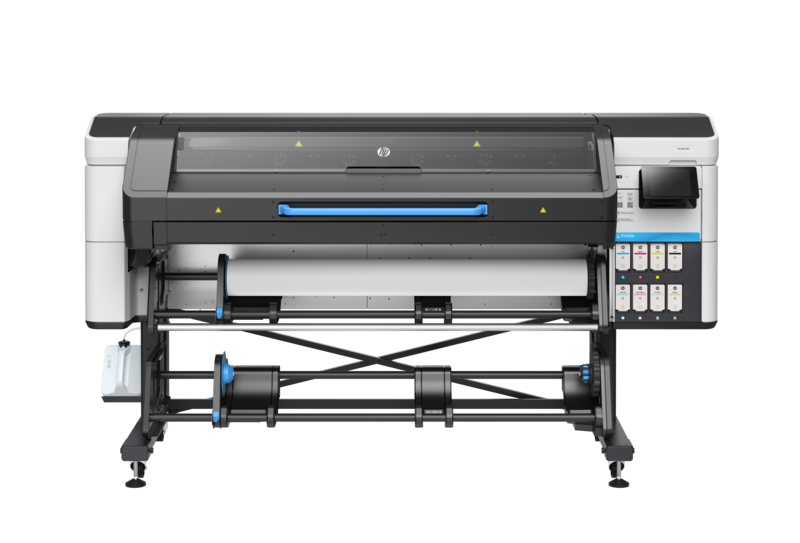
The HP Latex 730 is a 64-inch (1,625 mm) roll-to-roll large format printer designed for production signage, retail graphics, vehicle wrapping, textile applications, and interior decoration. It produces up to 31 m²/hr (334 ft²/hr) in 4-pass draft mode and 17 m²/hr (183 ft²/hr) in standard 8-pass mode using water-based HP 832 Latex inks in 1-litre cartridges. Maximum roll weight is 55 kg, reducing changeover downtime on long production runs. The 730 includes an HP Embedded Spectrophotometer for in-house ICC colour profiling and automated double-sided printing on PVC-free media. Prints exit dry and ready for immediate lamination, with no outgassing wait. Sold and serviced in South Africa by Graficomp, an HP Amplify Commercial Specialist and certified HP ASDP service partner.
The HP Latex 730W is the white ink configuration of the HP Latex 730 — same 64-inch chassis, same 31 m²/hr draft speed, same HP 832 Latex inks, same spectrophotometer and double-sided capability — with the addition of a dedicated white ink channel. The 730W enables printing on clear, metallic, dark, and backlit substrates using five white print modes (Spot, Underflood, Overflood, 3-Layer, 5-Layer). An Automatic Recirculation System (ARS) keeps white ink agitated at all times to prevent settling. 10 ink cartridges total (8 colour + 2 white). 10 HP 836 Latex Printheads. Sold and serviced in South Africa by Graficomp, an HP Amplify Commercial Specialist.
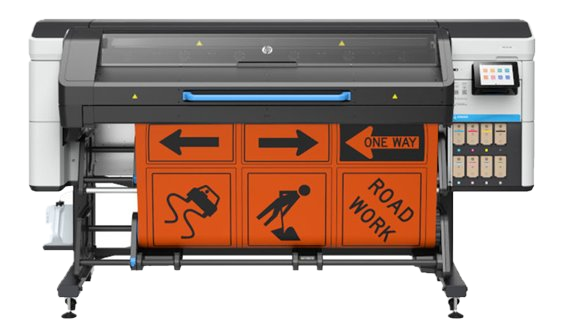

HP Latex 730 Printer producing retail signage with consistent colour across a multi-site brand rollout
HP Latex 730W Printer — white ink configuration for printing on clear, dark, and metallic substrates
Spec sheets show headline speeds. These are the operational advantages that determine your actual cost per square metre over three years of production.
Water-based HP Latex inks cost less per ml than UV-curable alternatives. For a production operation printing consistent volume, the ink cost difference over the life of the machine is a material financial advantage.
HP Latex prints directly on tissue paper, pure cotton, coated fabrics, canvas, and synthetic textiles when used with a liner. Textile and soft-signage — interior display, exhibition backdrops, flags, and custom apparel — is a growing revenue stream that UV and most eco-solvent systems cannot serve from the same machine.
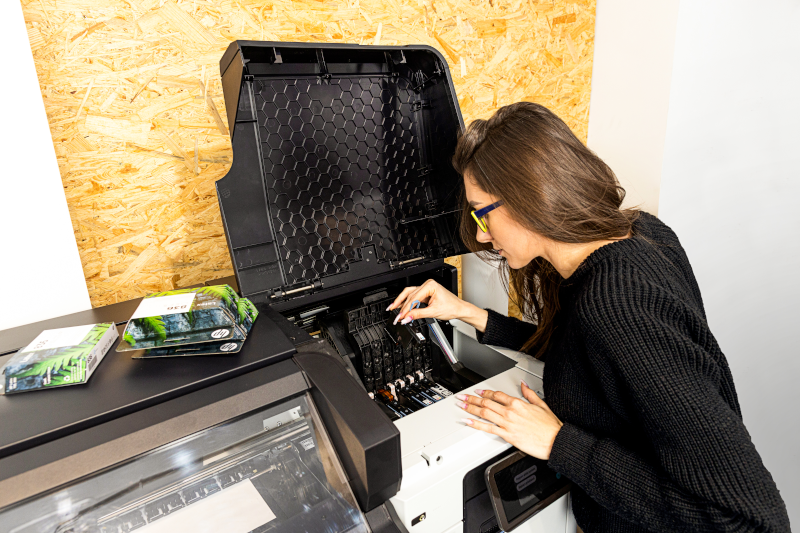
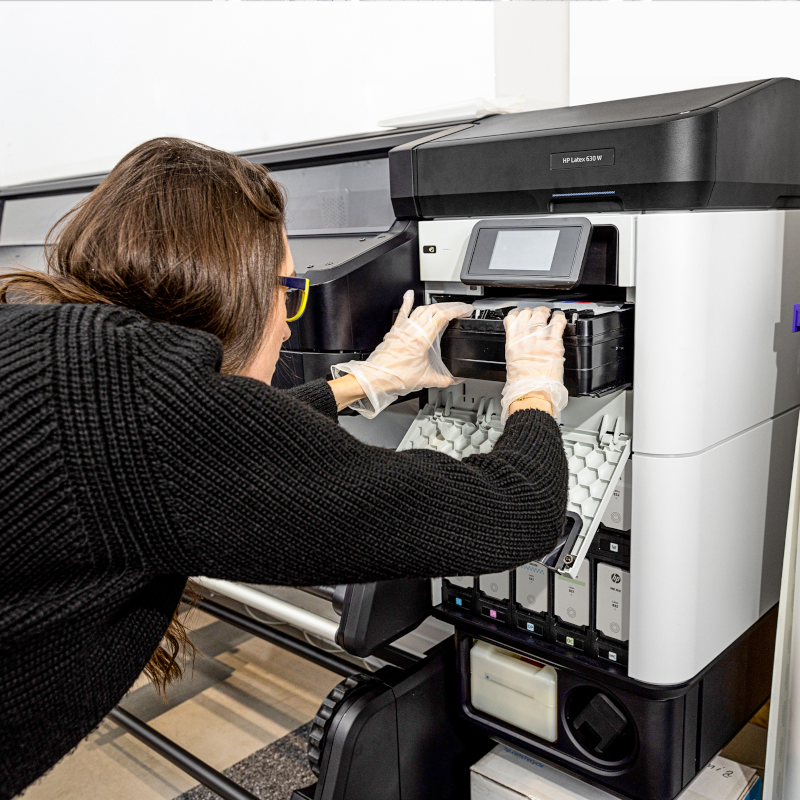
Head strikes happen. On HP Latex, replacing an HP 836 printhead takes under 10 minutes and requires no engineer on site. You order the head, install it yourself, and you are back in production the same day. On many competing platforms, a head strike means waiting for a technician and potentially days of downtime.
HP ships parts by air freight only — no sea freight. If a part is not already in South Africa, HP will fly it in within three business days. Most units and consumables are held in local SA stock. HP also delivers equipment free to any location in South Africa, saving thousands of rand for businesses in outlying areas.
South African print businesses on working with Graficomp.
We needed colour consistency across 14 store installations for a retail client. The embedded spectrophotometer on the 730 meant we could verify and adjust profiles in-house between runs. Not one reprint was required across the full campaign.
The 55 kg roll capacity means we can run through a full production day on a single roll of cast vinyl. Changeover time used to eat into our output numbers. That problem is gone.
The installation team was on-site within a week and stayed until we were printing at target quality. That level of handover is rare in this industry.
We moved from eco-solvent. No outgassing wait means same-day lamination. Our turnaround on retail jobs halved, and we opened indoor applications we couldn't touch before.
The rental structure made sense for our cash flow. Fixed monthly cost, HP-certified service included. We went from capital avoidance to owning a machine we couldn't have justified outright.
We needed colour consistency across 14 store installations for a retail client. The embedded spectrophotometer on the 730 meant we could verify and adjust profiles in-house between runs. Not one reprint was required across the full campaign.
The 55 kg roll capacity means we can run through a full production day on a single roll of cast vinyl. Changeover time used to eat into our output numbers. That problem is gone.
The installation team was on-site within a week and stayed until we were printing at target quality. That level of handover is rare in this industry.
We moved from eco-solvent. No outgassing wait means same-day lamination. Our turnaround on retail jobs halved, and we opened indoor applications we couldn't touch before.
The rental structure made sense for our cash flow. Fixed monthly cost, HP-certified service included. We went from capital avoidance to owning a machine we couldn't have justified outright.
The 730 is the production choice for shops running meaningful daily volume. Heavier rolls mean fewer changeovers. An embedded spectrophotometer closes the loop on repeat brand work. And automated double-sided printing on PVC-free media opens applications the HP Latex 630 cannot serve.
| Print Mode | Speed (m²/hr) | Speed (ft²/hr) | Pass Count | Typical Use |
|---|---|---|---|---|
| Draft (Banner) | ~31 | 334 | 4-pass | Event banners, economy PVC, short-run proofing |
| Speed | ~21 | 226 | 6-pass | General outdoor banners, self-adhesive vinyl, POS |
| Standard everyday | ~17 | 183 | 8-pass | Everyday production: signage, retail graphics, vinyl |
| Quality | ~16 | 172 | 12-pass | Photography, fine art, colour-critical brand work |
| High Quality | ~11 | 118 | 16-pass | Museum-quality prints, maximum colour saturation |
The 730 accepts rolls up to 55 kg (121 lb), directly reducing changeover downtime on long production runs. Rolls from 18 to 64 inches are supported (full take-up reel support from 23 inches). Maximum roll diameter is 249 mm (9.8 in). The 730 also supports automated double-sided printing on PVC-free media — a capability not available on the HP Latex 630. The spindle-less front-loading system and leading-edge media saving reduce setup waste on compatible substrates.
Unlike the HP Latex 630, the 730 includes an HP Embedded Spectrophotometer. Production teams can create custom ICC profiles in-house and verify colour consistency across repeat brand rollouts without sending substrates to an external profiling lab. For print service providers managing multi-site installations or long-running brand contracts, this is a direct reduction in reprints and client sign-off cycles.
The spectrophotometer is HP-proprietary and calibrates significantly faster than previous generations. This also supports closed-loop colour calibration as printheads are replaced over time, maintaining output consistency without manual intervention.
HP Pixel Control is a digital pipeline that delivers uniform colour distribution and smooth gradients through precise ink mixing. The result: sharper text (down to 4-point), deeper solids, and consistent colour rendering panel to panel. In beta testing, shops that previously ran 12-pass for colour-critical work moved to 8-pass with equivalent quality. That is a throughput gain of roughly 50% on those jobs with no reduction in output standard.
HP Latex inks print on coated polyester, backlit textile, canvas, synthetic blends, and natural fibres including pure cotton and tissue paper when used with a liner. Applications include soft-signage, exhibition backdrops, interior display fabric, flags, and custom apparel. This is an application category UV and most eco-solvent platforms cannot serve from the same machine. The HP Latex 730 Textile Kit Accessory is required for long runs of porous textile.
HP 832 Latex inks are water-based and contain no Hazardous Air Pollutants. No special ventilation is required for the ink chemistry. When printing on PVC-based vinyl or banner media, mild off-gassing can occur from the media plasticisers during curing — this is the substrate, not the ink. For completely odour-neutral output, HP PVC-free substrates and paper-based media produce no detectable odour.
The 730W adds a dedicated white ink channel to the full 730 platform. White ink unlocks substrates that are otherwise unprintable: clear films for window graphics, metallic vinyls, dark or black substrates, and backlit media where white opacity is required for colour vibrancy. Five white modes give precise control over opacity and construction.
White ink contains titanium dioxide particles that settle rapidly if left static. The ARS continuously circulates white ink through the cartridge and printhead system whenever the machine is powered, preventing pigment settling without any operator intervention. No manual shaking, no daily purge routine — the system manages ink maintenance automatically.
Window vinyl graphics (clear film), backlit lightbox panels, fleet graphics on silver or chrome vinyl, dark or black substrates for retail POS, frosted or etched-glass effect films, and double-sided backlit graphics where front-facing and reverse-facing images must both be colour-accurate.
HP 832 Latex inks achieve a 7-year outdoor durability rating on laminated 3M cast vinyl under 3M MCS Warranty specifications. Unlaminated prints on standard calendered vinyl are rated for up to 3 years outdoors, comparable to eco-solvent on the same substrates without lamination.
All figures from the HP Latex 730 product datasheet (May 2025). Metric primary; imperial in brackets where relevant for South African buyers.
| Specification | Value |
|---|---|
| Print Technology | HP Latex Printing Technologies (thermal inkjet) |
| Ink System | Water-based HP 832 Latex Inks — 1-litre cartridges |
| Ink Cartridges | 8: Cyan, Magenta, Yellow, Black, Light Cyan, Light Magenta, Optimizer, Overcoat |
| Ink Cartridges | 10: Cyan, Magenta, Yellow, Black, Light Cyan, Light Magenta, Optimizer, Overcoat + 2 dedicated HP 832 Latex White |
| Max Media Width | 1,625 mm (64 inches) |
| Standard Speed (8-pass) | ~17 m²/hr (183 ft²/hr) |
| Draft Speed (4-pass) | ~31 m²/hr (334 ft²/hr) |
| Max Print Resolution | 1,200 x 1,200 dpi |
| Printheads | 8 HP 836 Universal Latex Printheads (user-replaceable) |
| Printheads | 10 HP 836 Universal Latex Printheads — 8 colour + 2 dedicated White (user-replaceable) |
| Roll Size Supported | 18 to 64-inch rolls (23 to 64-inch with full support) |
| Max Roll Weight | 55 kg (121 lb) |
| Max Roll Diameter | 249 mm (9.8 inches) |
| Max Substrate Thickness | 0.5 mm (19.7 mil) |
| Spectrophotometer | HP Embedded Spectrophotometer (included) |
| Double-Sided Printing | Automated, PVC-free media only |
| Media Types | Canvas, Polyester films, PVC Banners, PVC-free Banners, Papers, Self-Adhesive vinyls, PP and PE synthetics, Textile, Wallcoverings |
| Media Handling | Roll feed, take-up reel, wiper roller, media saver, automatic horizontal cutter (vinyl, banner, canvas, paper-based media, film) |
| RIP Software Included | HP SAi Flexi Print and Cut Basic (Windows only) |
| Connectivity | Gigabit Ethernet (1000Base-T) |
| Power Requirements | 200-240 V, single-phase, 50/60 Hz, two power cords |
| Power Consumption | 1.5-2.5 kW printing (5 kW peak), 95 W ready, 19 W sleep |
| Operating Temperature | 15 to 30°C (59 to 86°F) |
| Operating Humidity | 20 to 80% RH (non-condensing) |
| Dimensions (W x D x H) | 258.3 x 85.3 x 140.2 cm (101.7 x 33.6 x 55.2 in) |
| Product Weight | 261 kg (575.4 lb) |
| Product Weight | ~267 kg (588.6 lb) — white ink system adds approx. 6 kg |
| White Print Modes | Spot White, Underflood White, Overflood White, 3-Layer White (WCW), 5-Layer White (WCWCW, up to 260% density) |
| White Ink Maintenance | Automatic Recirculation System (ARS) — continuous agitation, no manual intervention required |
| Environmental Certifications | ENERGY STAR, RoHS, REACH, EPEAT Gold + Climate+, AgBB, French VOC A+, UL GREENGUARD Gold, UL ECOLOGO, CE |
| Warranty | 1-year limited hardware warranty |
| HP Part Number | 870B7A |
| HP Part Number | 869Z6A (730W) — verify against current HP datasheet |
Graficomp is not a box-mover. Every HP Latex 730 purchase includes commissioning by a certified HP engineer and operator training before the machine enters production. We carry 40 to 50 years of combined engineering experience on the HP DesignJet and Latex ranges.
HP Amplify is HP's global partner programme for authorised resellers and service organisations. Specialist status is not automatic — it requires demonstrated technical competency, customer satisfaction metrics, and a minimum volume of certified deployments. Graficomp holds Commercial Specialist designations across two distinct solution areas within the Large Format portfolio, as well as Synergy Commercial Partner status.
When you buy an HP Latex 730 through Graficomp, you are buying through a partner that HP recognises as qualified to deliver the full solution: hardware, installation, training, and ongoing service. That is what HP Amplify Specialist status means in practice.


HP delivers equipment free to any location in South Africa, including outlying areas where freight costs from other suppliers can run into thousands of rand. Graficomp's engineers travel to site for installation across all regions.
| Buyer Condition | Recommended Model |
|---|---|
| Moving up from eco-solvent; moderate daily volume; no spectrophotometer required | HP Latex 630 |
| Need white ink for window graphics, backlit, or dark substrates (lower volume) | HP Latex 630W |
| Daily volume above 20 m²; repeat brand clients; rolls over 42 kg; embedded spectrophotometer required | HP Latex 730 (this page) |
| Need white ink on the 730 platform (same chassis + spectrophotometer + white ink) | HP Latex 730W — toggle above |
| High-volume operation; speed parity with eco-solvent required | HP Latex 830 |
| Need to print on rigid substrates as well as roll media | HP Latex R530 (separate category) |
Each answer is written to stand alone — optimised for AI-assisted search and passage retrieval. These are the questions Graficomp's sales team actually receives from buyers researching the 730.
Maximum roll diameter is 249 mm (9.8 inches). Maximum roll weight is 55 kg (121 lb). Rolls from 18 to 64 inches are accepted; rolls from 23 to 64 inches receive full take-up reel support.
The HP Embedded Spectrophotometer allows production teams to create custom ICC colour profiles in-house and verify colour consistency across print runs without external profiling equipment. For shops managing repeat brand contracts or multi-site installations, this reduces reprints and external lab costs.
The spectrophotometer also maintains colour accuracy automatically as printheads are replaced over the life of the machine.
Yes. The HP Latex 730 supports automated double-sided printing on PVC-free media. This is not available on the HP Latex 630.
No. HP 832 Latex inks are water-based and contain no Hazardous Air Pollutants. No special ventilation is required for the ink. When printing on PVC-based vinyl or banner media, mild off-gassing can occur from the media plasticiser during curing — this is from the substrate, not the ink.
Yes. The HP Latex 730 integrates with the HP PrintOS platform, providing real-time production monitoring, job status, and printer health data from any connected device via browser. HP PrintOS Production Hub premium features require an HP Professional Print Service Plus Plan.
HP 832 Latex inks achieve a 7-year outdoor durability rating on laminated 3M cast vinyl under 3M MCS Warranty specifications. Unlaminated output on standard calendered vinyl is rated up to 3 years, comparable to eco-solvent on the same substrates.
HP Latex printers perform automatic maintenance routines to preserve printhead condition during idle periods. Water-based HP Latex inks do not dry and harden in the printheads during normal idle cycles. Contact Graficomp if the machine will be unused for an extended period.
HP SAi Flexi Print and Cut is included. It runs on Windows only. Mac-based workflows require a third-party RIP such as Caldera. Graficomp can advise on the correct configuration before purchase.
HP 836 Latex printheads are user-replaceable. No engineer is required on site. The HP 836 is a universal printhead — one SKU covers all 6 colour channels, reducing the inventory you need to keep on hand. Replacement takes under 10 minutes. The machine runs automatic calibrations after installation.
Yes. HP Latex inks print on coated polyester, backlit textile, canvas, synthetic blends, and natural fibres including pure cotton and tissue paper when used with a liner. This includes soft-signage, exhibition backdrops, interior display fabric, flags, and custom apparel. The HP Latex 730 Textile Kit Accessory is required for long runs of porous textile.
The three primary differences are: (1) the 730 includes an HP Embedded Spectrophotometer for in-house ICC profiling — the 630 does not; (2) the 730 accepts 55 kg rolls versus 42 kg on the 630, reducing changeover downtime on long runs; (3) the 730 supports automated double-sided printing on PVC-free media, which the 630 does not.
Both machines use HP 832 inks, 1-litre cartridges, and HP 836 user-replaceable printheads.
Specify the 730W when your substrate mix includes any of the following: clear films for window graphics, silver or chrome metallic vinyl for fleet graphics, dark or black substrates for retail POS or signage, or backlit lightbox panels where white opacity is required to achieve colour vibrancy.
If your work is exclusively on white or light-coloured media, the standard 730 is the more cost-effective choice. The 730W costs more per cartridge set and requires the ARS to run continuously — a worthwhile trade-off when you need white ink, not otherwise.
White ink contains titanium dioxide particles that settle rapidly if left static. The ARS continuously circulates white ink through the cartridge reservoir and printhead circuit whenever the machine is powered on, preventing pigment separation without any operator action.
No manual shaking, no daily purge routine. If the machine will be off for an extended period, contact Graficomp for the correct shutdown procedure to protect the white ink system.
Spot White: White ink only, no colour overlay. Used for logos, text, or registration marks on clear, metallic, or dark substrates.
Underflood White: White base coat printed under colour. Brings the full colour gamut to dark or metallic substrates — white first, then colour over the top.
Overflood White: Colour printed first, white overprinted on top. Used for backlit applications where the image is viewed from the reverse side of a clear substrate.
3-Layer White (WCW): White-Colour-White sandwich construction for maximum opacity on clear substrates and double-sided backlit graphics.
5-Layer White (WCWCW): Maximum white density construction, up to 260% ink density. Used where the highest opacity is required regardless of throughput speed.
Graficomp's team can match you to the right machine for your volume, substrate mix, and workflow. No pressure — useful information whether you buy now or in 12 months.